Kaiwa kit
Assembly Manual :
https://docs.google.com/document/d/1YqtZGcR0a9y3dSaS41rJ2dpXWgq_nbGpbouSVJeHrYA/edit?usp=sharing
Quickstart manual: https://www.polaxis.be/download/kaiwa-quickstart-manual/
For more information, check the assembled Kaiwa
Emy Kit
See the assembly manual
Kaiwa Assembled
Prepare your text file in Romaji and have Kaiwa read it out loud for you!
Just in case you wonder how Romaji look like: here is the Japanese lyrics of Kraftwerk’s Radioactivity :
cherunobuiri
harisuba-gu
serafi-rudo
hiroshi-ma
fukushi-ma
nihon,demo,houshanou
kyoumo,itsumademo
fukushima,houshanou
kuuki,mizu,subete
nihon,demo,houshanou
i-ma--sugu,ya-mero-
note: the hyphen is used to prolong the vowels (see the Kaiwa-vox’s manual for more on this)
Workflow
Group your lines into a song and save it as a text file on the SD card :
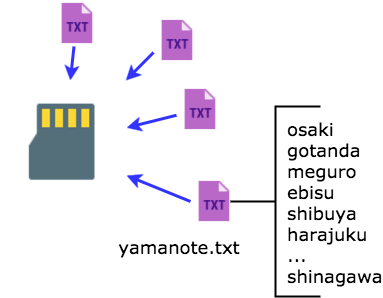
On Kaiwa, manually pick a song and use the Sound pot or its CV entry to pick the line in that song.
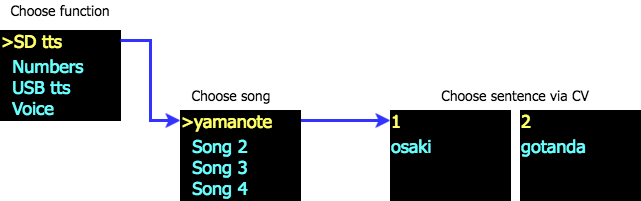
A gate signal will trigger the sound while the various pot and CV entries allow tweaking the voice characteristics before processing the speech (not in real-time, but they are applied on the next utterance).
Kaiwa Manual
Firmware

Kaiwa Firmware 28.03 KB 638 downloads
Firmware load : Option 1 Saving the "firmware.bin" on the SD card and restart Option...Login is required to access this page
SD card
(if you need to get started with a new sd card)

Kaiwa SD card 1.36 KB 11463 downloads
Image of Kaiwa's default SD card. It contains some files to get started Unzip and...Quickstart Manual
USB TTS mode
This little demo to shows how to use the USB TTS mode on Kaiwa. This function is designed to help you debug your Japanese romaji lines before storing them into a text file for the SD card. (see the user manual for more details).
The speech is triggered by the gate signal, so this mode can also be used to edit and play live text.
Media
Emy Assembled
TMS5220/TMS5100 speech engine
- LPC data are read from the SD card so an infinite vocabulary can be loaded
- Sound and vocabulary can be produced by concatenating allophones and prosody markers from the text file to affect rate, duration, and pitch. No limits here!
- The OLED crisp display allows browsing amongst the files and the lines within files to pick the sound the user wants to generate.
- Speech rendering can be tweaked in real-time to affect, rate, stretch, bend, pitch, and energy.
- All the potentiometers have CV entries attached to them
- Emy produces sounds in 3 major modes: Speech, Repeat, and VCO.
- In Speech mode, the speech starts with a gate signal and is completed before waiting for a new gate signal. The speech has priority.
- In Repeat mode, the speech starts and stops with the gate signal going high or low.
The gate has the priority, and the speech repeats while the gate is high. This mode is handy to create crazy rhythms. - In VCO mode, the LPC engine loops while the gate is high, producing steady notes.
Technical Details
- 16 hp
- micro SD card reader to read the text or update the firmware
- Diode for reverse polarity protection on power lines
- Consumption : +12V 60mA / -12V 18 mA
- Cortex-M0 ARM processor
- All inputs: 100k impedance, 12-bit ADC.
- CV control designed for 0-5 V entries
- aux out signal 5V
- OLED display
- mikroBUS host
- Output level 8 Vpp
- A USB port for communication, firmware updates, and USB keyboard text entry
Firmwares
Emy MIDI Serial 95.37 KB 61978 downloads
This firmware works both on Emy 2018 and 2019 editions. It allows Emy to behave like...
Emy MIDI USB 79.49 KB 61581 downloads
This firmware works both on Emy 2018 and 2019 editions. It allows Emy to behave like...
Emy Firmware 65.95 KB 115587 downloads
This firmware is designed for Emy 2019 edition (PCB revision 1.0c). It can run on...SD card
(if you need to get started with a new sd card)
Emy SD card image 32.99 KB 9110 downloads
Image of Emy's default SD card. It contains some .lpc files and .phon files to get...More files
Emy
View AllMIDI
The MIDI version of the code (see above in Firmware) works great with this Ableton preset file

Emy Ableton MIDI to allophones effect rack 7.87 KB 38498 downloads
MIDI notes are renamed so they match Emy's allophones table This makes it easier...Manuals
Emy user manual
Emy kit assembly manual

Emy 2018 quickstart manual 569.91 KB 398468 downloads
Have a look at this little quick start manual to get started using the Emy 2018 speech...
Emy 2019 quick start manual 3.78 MB 176427 downloads
Have a look at this little quick start manual to get started using the Emy 2019 speech...Media
https://www.youtube.com/embed/JkEYwAl6exk
//platform.instagram.com/en_US/embeds.js
//platform.instagram.com/en_US/embeds.js
T-shirt Polaxis
Polaxis T-Shirt size Europe
Mea vox
Firmware
Mea Firmware + MIDI USB 62.44 KB 419 downloads
Firmware load : Option 1 Saving the "firmware.bin" on the SD card and restart Option...Login is required to access this page
Mea Firmware + MIDI TRS 62.44 KB 17 downloads
Please note that when using MIDI from the TRS jack on Terminal, the front switch...Login is required to access this page
SD Card
(if you need to get started with a new SD card)

Extras
Citroen / Renault 25 vocabulary for MEA vox
6 file(s) 163.27 KB
Login is required to access this page
Mea Manual for Emy/Terminal
MIDI
The firmware has a MIDI function :
– MIDI note assigned to 39 phonemes.
– Velocity and Pitch bend supported.
– Can hold the note for singing effect.
Ableton MEA vox MIDI effect rack 40 12.07 KB 2558 downloads
Midi notes are named to match Mea's 40 phonemes. (See MIDI mode in the manual) ...Login is required to access this page
Use with a microcontroller
The hardware is compatible with the mikroBUSTM standard, allowing rapid prototyping and easy integration into existing projects.
The onboard class-d amplifier can drive a small 8 ohms speaker.
This vox board was designed to be used with EMY and its appropriate firmware. (in this case, the audio signal is forwarded via the “PWM” pin – the jack is not used with Emy)
It can also be used in robots, toys, or any other retrocomputing speaking devices you may think of.
Thanks to the popular mikroBUS™, this board can be instantly connected to multiple different platforms like the Arduino, the STMT32 of the Clicker2.
The onboard amplifier is quite powerful and is just waiting for the speaker to be plugged in!
Breadboard Connection
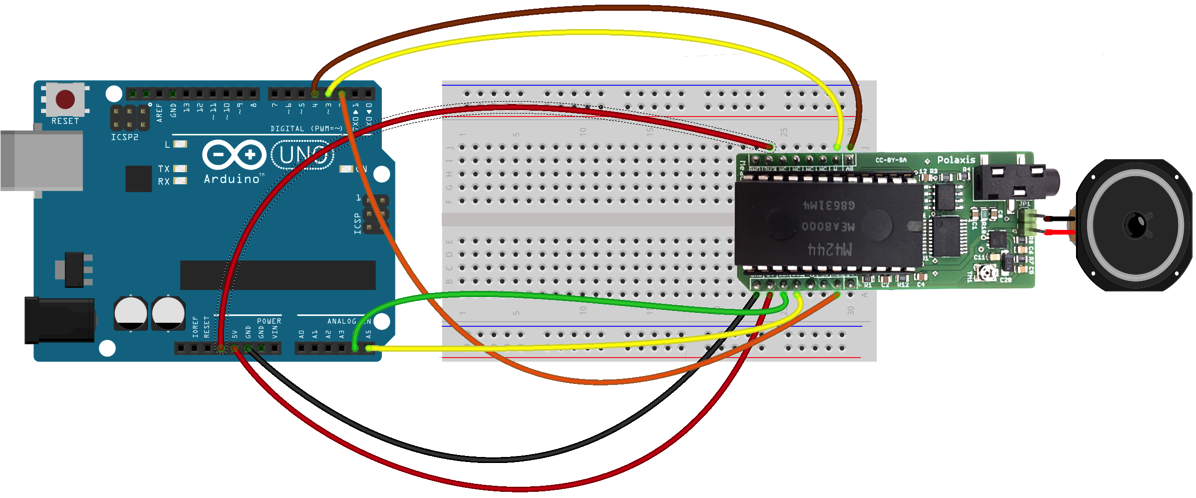
Code
The code is available here
Text to Speech
The chip can string phonemes to produce quite realistic speech (although with a French accent). It can also sustain notes for a nice singing effect. Here is how the Arduino code looks like :
dire("/bonj+w_r");
delay(400);
dire("&l&kt€Ronik miwzik");
delay(400);
dire("i$ b+i-n ka+I+n -ma/$=+_ine");
delay(400);
dire("+?je pE ossi murmur*?");
delay(400);
dire("je suis un arduino qui parle"); // à corriger ;-)
delay(400);
You will find more information about the various phonemes and the prosodic markers in the following manual.
Hardware User Manual
Mea hardware manual
Media
Voir cette publication sur Instagram
Voir cette publication sur Instagram
Voir cette publication sur Instagram
Kaiwa vox
Kaiwa Vox is a text-to-speech add-on board with a Japanese robotic voice.
It just needs to receive an ASCII string of Romaji Japanese to start speaking.
The speech engine recognizes text and various speech modifiers to improve prosody.
The chip can also vary the speech’s speed, pitch, and accent.
The hardware is compatible with the mikroBUSTM standard, allowing rapid prototyping and easy integration into existing projects.
The onboard class-d amplifier can drive a small 8-ohms speaker.
A LED turns on when the chip has finished talking and is ready to proceed.
Technical specifications
- 8 Khz PWM, low pass filtered un-amplified audio output
- Onboard 1.4W into 8 ohms class-D amplifier
- 3.5 mm mono jack or 2.54 mm header speaker connections
- Power by 3.3V or 5V by cutting trace or soldering another (5Vis set by default)
- Green LED on when ready.
- Hardware reset signal possible to reset the speech chip
Kaiwa vox hardware manual
Kaiwa Manual
Applications
This vox board is designed for Emy or Terminal (in this case, the audio signal is routed via the “PWM” pin – the jack is not used here)
It can also be used in robots, toys, or any other speaking device you may think of.
Thanks to the popular mikroBUS™, this board can be connected to multiple platforms like the Arduino or the STM32.
The onboard amplifier is quite powerful and is just waiting for the speaker to be plugged in!
Firmware
Code example
#include "AquesTalk.h"  // http://www.a-quest.com/download/package/Arduino_AquesTalk_Library.zip
#include

/*

         +-----------------+
         |[ ]NC      OUT[ ]| Audio
       3 |[ ]RST   !PLAY[ ]| 2
         |[ ]NC       NC[ ]|
         |[ ]NC       NC[ ]|
         |[ ]NC      SCL[ ]| A5
         |[ ]NC      SDA[ ]| A4
         |[ ]3V3      5V[ ]| 5V
         |[ ]GND     GND[ ]| GND
         +________________/
*/

AquesTalk atp;  // I2C address : 0x2E
#define RESET 3
#define NPLAY 2 // busy playing when LOW


void setup()
{
    pinMode(RESET, OUTPUT);
    digitalWrite(RESET, HIGH);
    pinMode(NPLAY,INPUT_PULLUP);

  delay(100);
  atp.Synthe("konnnichiwa.");

}

void loop()
{
   atp.Synthe("arigato.");
   atp.SetAccent(random(200));
   atp.SetPitch(random(200));
   atp.SetSpeed(random(200));
   atp.Synthe(".");

}
Github
The Arduino code is available here.
Talko 1 assembled module
This module is performing real-time LPC synthesis to produce an intelligible voice or … not if you choose to.
The module produces sounds in 3 major modes: Speech, Repeat, and VCO.
Talko is an Arduino-based synthesizer developed under open-source hardware and software. (license CC-BY-SA)
Its firmware can be updated via the onboard USB port.
Please note that building & coding this module requires minimum Arduino knowledge like installing a com port, installing libraries & uploading code.
Technical details
– format: Eurorack
– width: 10hp
– depth: 30 mm skiff friendly
– power: + 12V: 65 mA via 10 pin Doepfer power bus
– audio: un-filtered 5V PWM carrier at 62500 Hz
– inputs: protected against over or under voltage by clipping from 0 to +5V
User Manual
The user manual can be found here: https://www.polaxis.be/wp-content/uploads/2016/05/Talko-Manual-1_2.pdf
Technical support
https://github.com/deladriere/euro-modules/tree/master/Talko
Latest firmware

Easy Uploader

More Downloads